CME to Launch Bitcoin Volatility Futures, Unlocking New Hedging Strategies for Institutions: LatestDeFiNews
CME Group is set to introduce Bitcoin volatility futures on June 1, pending regulatory approval. This new offering will allow institutional traders to bet on the degree of Bitcoin's price swings, rather than its direct price, marking a significant evolution in regulated crypto derivatives.
Why it matters
The Chicago Mercantile Exchange (CME) Group is poised to launch Bitcoin volatility futures on June 1, a move that signifies a major maturation in the crypto derivatives market. These new contracts will track the CME CF Bitcoin Volatility Index (BVX) instead of Bitcoin's spot price, enabling traders to speculate on the extent of price fluctuations. This development provides a regulated, onshore avenue for institutions to hedge against or capitalize on Bitcoin's volatility, expanding beyond existing options and further cementing Bitcoin's institutional integration following the success of spot ETFs and their associated options.
Market focus
Key takeaways
- CME Group plans to launch Bitcoin volatility futures on June 1, pending regulatory approval, offering a new regulated product for crypto markets.
- These futures will track the CME CF Bitcoin Volatility Index (BVX), allowing traders to bet on the degree of price swings rather than direct price direction.
- The offering provides institutional investors with a crucial tool for risk management and hedging against Bitcoin's volatility, expanding beyond existing offshore options.
- This move signifies a further maturation of the crypto derivatives market and accelerates Bitcoin's institutional integration, mirroring the evolution of traditional financial products like the VIX.
- Traders gain a new avenue for sophisticated strategies, potentially enhancing market liquidity and providing a clearer 'fear gauge' for Bitcoin.
CME Set to Introduce Bitcoin Volatility Futures
The Chicago Mercantile Exchange (CME) Group, a titan in the derivatives world, has announced plans to launch Bitcoin volatility futures on June 1, pending regulatory approval. This forthcoming product represents a significant leap forward for institutional engagement in the crypto market, offering a sophisticated tool for managing risk and speculating on market dynamics beyond simple price direction.
Beyond Price: Understanding Volatility Futures
For many, cryptocurrency trading boils down to a binary question: will prices rise or fall? However, a crucial dimension often overlooked is volatility – the measure of how much prices are expected to fluctuate, irrespective of their upward or downward trajectory. While a staple in traditional equity markets, particularly with indices like the VIX, a regulated, onshore Bitcoin volatility product has been conspicuously absent.
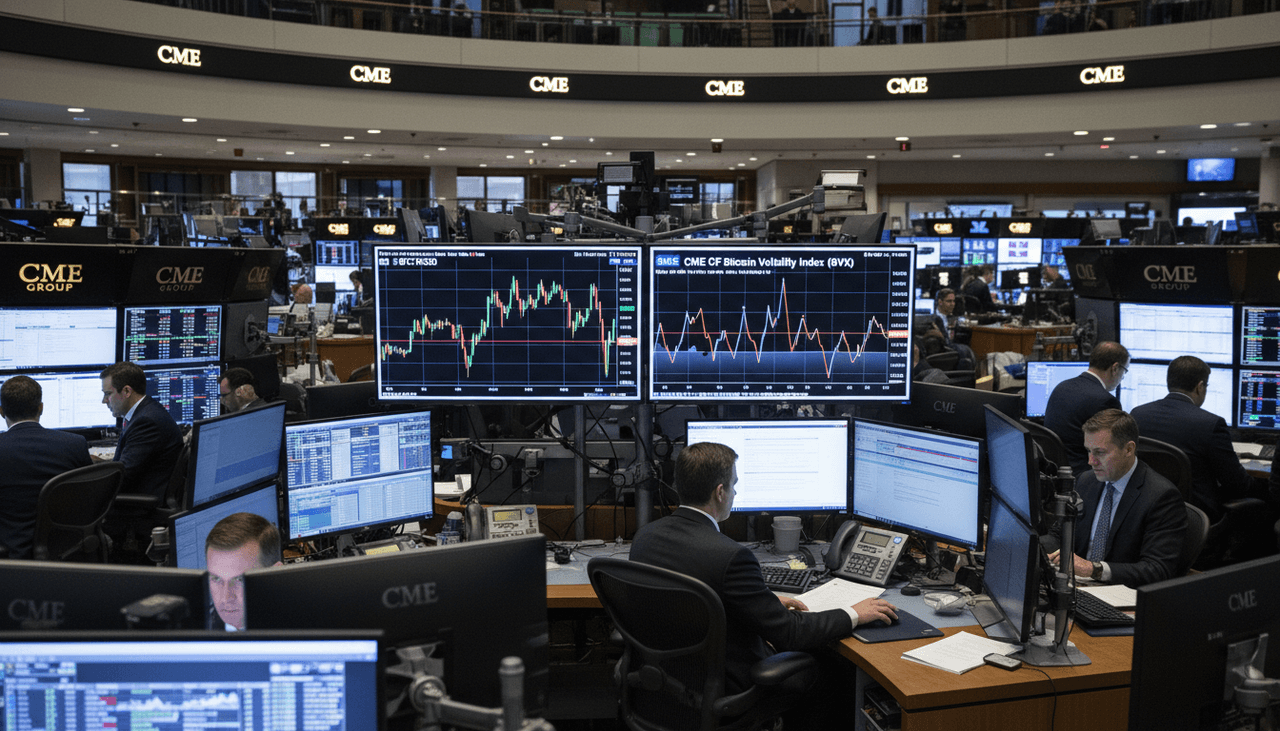
Unlike traditional Bitcoin futures, which track the cryptocurrency's price directly, these new CME contracts will reference the CME CF Bitcoin Volatility Index (BVX). The BVX is designed to reflect the market's expectations for Bitcoin's volatility over a four-week period. This means traders will be able to take positions on whether Bitcoin markets are likely to become more turbulent or more stable, without needing a directional view on Bitcoin's price itself.
"Crypto market participants are seeking regulated products that provide opportunities to gain digital assets exposure when markets move," stated Giovanni Vicioso, global head of cryptocurrency products at CME Group. "With our new Bitcoin volatility futures, traders will be able to invest or hedge against the future volatility of bitcoin, allowing them to access a critical new layer of risk management."
Why This Matters: Institutional Demand and Risk Management
The introduction of Bitcoin volatility futures by CME underscores the accelerating institutionalization of the crypto asset class. Institutions, particularly those in the U.S., have long sought regulated avenues to manage their crypto exposure. While offshore exchanges like Deribit offer futures tied to their own Bitcoin volatility indices, these markets are often inaccessible to U.S. institutions due to regulatory constraints and comparatively smaller liquidity pools.
CME's offering fills a critical gap, providing a familiar and regulated framework for institutions to gain volatility exposure or, more importantly, to hedge against it. This expands CME's existing suite of Bitcoin products, which includes highly successful Bitcoin futures and options contracts that have seen billions in trading volume and open interest, at times even surpassing major offshore platforms.
The Evolving Derivatives Landscape
The trajectory of institutional adoption in Bitcoin has been clear, from the launch of CME's initial futures in 2017 to the debut of 11 spot Bitcoin ETFs in January 2024. The subsequent rapid rise in popularity and open interest for options tied to these ETFs, such as BlackRock's IBIT, further signals a robust demand for sophisticated risk management tools.
Sam Gaer, chief investment officer of Monarq Asset Management's Directional Fund, views CME's volatility futures as a "natural next step." He draws parallels to the evolution of volatility trading in traditional markets, noting that the CBOE Volatility Index (VIX) only achieved deep liquidity after exchange-traded funds and structured products built around VIX futures created a self-reinforcing ecosystem. The success of IBIT options, surpassing even Deribit in open interest, provides a clear precedent for institutional appetite for such products.
Market Implications: Liquidity, Strategy, and the "Fear Gauge"
For traders and investors, CME's Bitcoin volatility futures open up a new dimension of strategic possibilities. Beyond directional bets, participants can now implement more nuanced strategies, such as selling volatility when they expect market calm or buying it ahead of anticipated turbulence. This could lead to more efficient pricing of options and other derivatives, as well as providing a cleaner way to express views on market uncertainty.
The product is expected to attract significant institutional capital, potentially enhancing overall market liquidity and depth. As a regulated, onshore instrument, it will likely become a benchmark for Bitcoin's implied volatility, akin to how the VIX serves as a "fear gauge" for the S&P 500. This could offer valuable insights into market sentiment and future price expectations, benefiting all participants in the broader crypto ecosystem.
What Traders Should Watch Next:
- Regulatory Approval: While expected, final regulatory clearance remains a key hurdle.
- Initial Liquidity: Monitor trading volumes and open interest in the first few weeks post-launch to gauge institutional adoption.
- Impact on Options Markets: Observe how the new futures interact with and potentially influence pricing in existing Bitcoin options markets.
- Correlation with Spot Price: Analyze how volatility futures movements correlate with significant Bitcoin price action, offering new predictive insights.
FAQ
How do Bitcoin volatility futures differ from traditional Bitcoin futures?
Traditional Bitcoin futures allow traders to speculate on the future price direction of Bitcoin (whether it will go up or down). Bitcoin volatility futures, however, allow traders to bet on the *degree* of expected price movement (how much prices will swing) over a specific period, regardless of the direction, using an index like the CME CF Bitcoin Volatility Index (BVX).